Dining in Paris Is Not Always Paradise

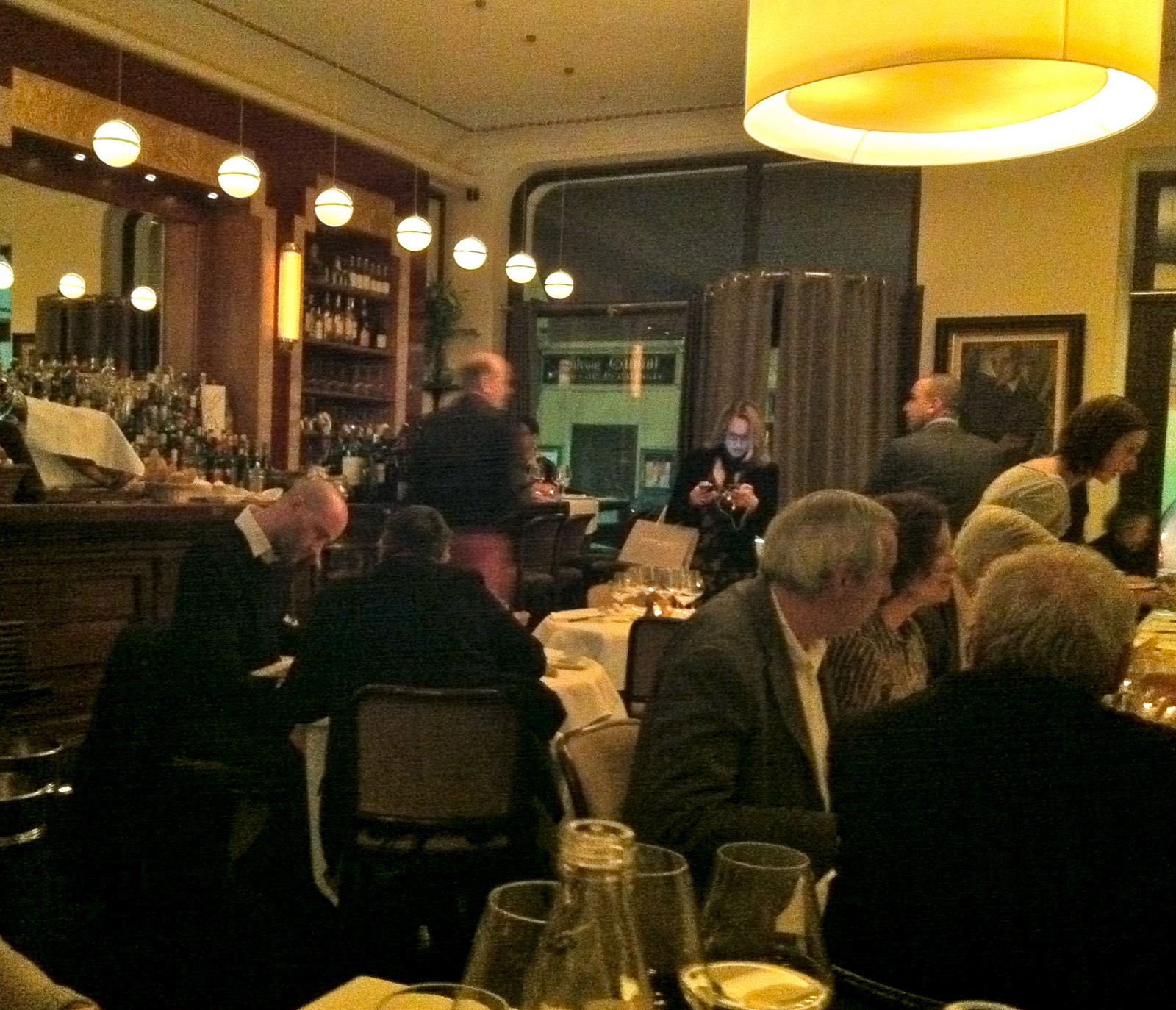
Although recommended by both critics and Parisian friends, Bistro Volnay, a restaurant near l’Opéra, was a disappointment. The ambience was certainly chic. Tables were covered with crisp, starched white linens, an attractive banquette ran down the length of one wall, and lighting was subdued and seductive. 
The first indication that the evening might be challenging occurred when our waitress insisted on using English when the four diners at our table all spoke French. Next, an amuse bouche, a little terrine of cooked pork, or rillettes, with toasted baguette slices was set in front of us. The former was tasty, but the croutons were not crisp and had been held too long.
When the first courses arrived, three turned out to be barely warm. My spouse’s foie gras was perfect, but bowls of silky smooth Jerusalem artichoke soup ladled over mounds of spinach, and my poached egg served over a rabbit ragoût were all tepid. This sad trend continued with the main courses when a beautiful slice of cod arranged over a pastry tart had to be returned to the kitchen for reheating.
What happened next was a first for me in Paris dining. We noticed diners around us enjoying interesting dishes that we hadn’t seen on the menu.  When we asked one of the servers where they were listed, we were told that they were specials of the day. Apparently our waitress had “forgotten” to mention them!
Dessert ended on a better note. My tarte tatin, a combo of rich amber-hued caramelized apples resting upon a deep golden puff pastry crust, was excellent. Riz au lait (creamy rice pudding) and a Mont Blanc, a dessert prepared with crispy meringue, chestnut puree, and whipped cream, were tempting enough to help assuage some of our earlier frustrations.
Bistro Volnay
8, rue Volnay
Paris 2
www.bistrovolnay.fr
Spicing Things Up in Paris

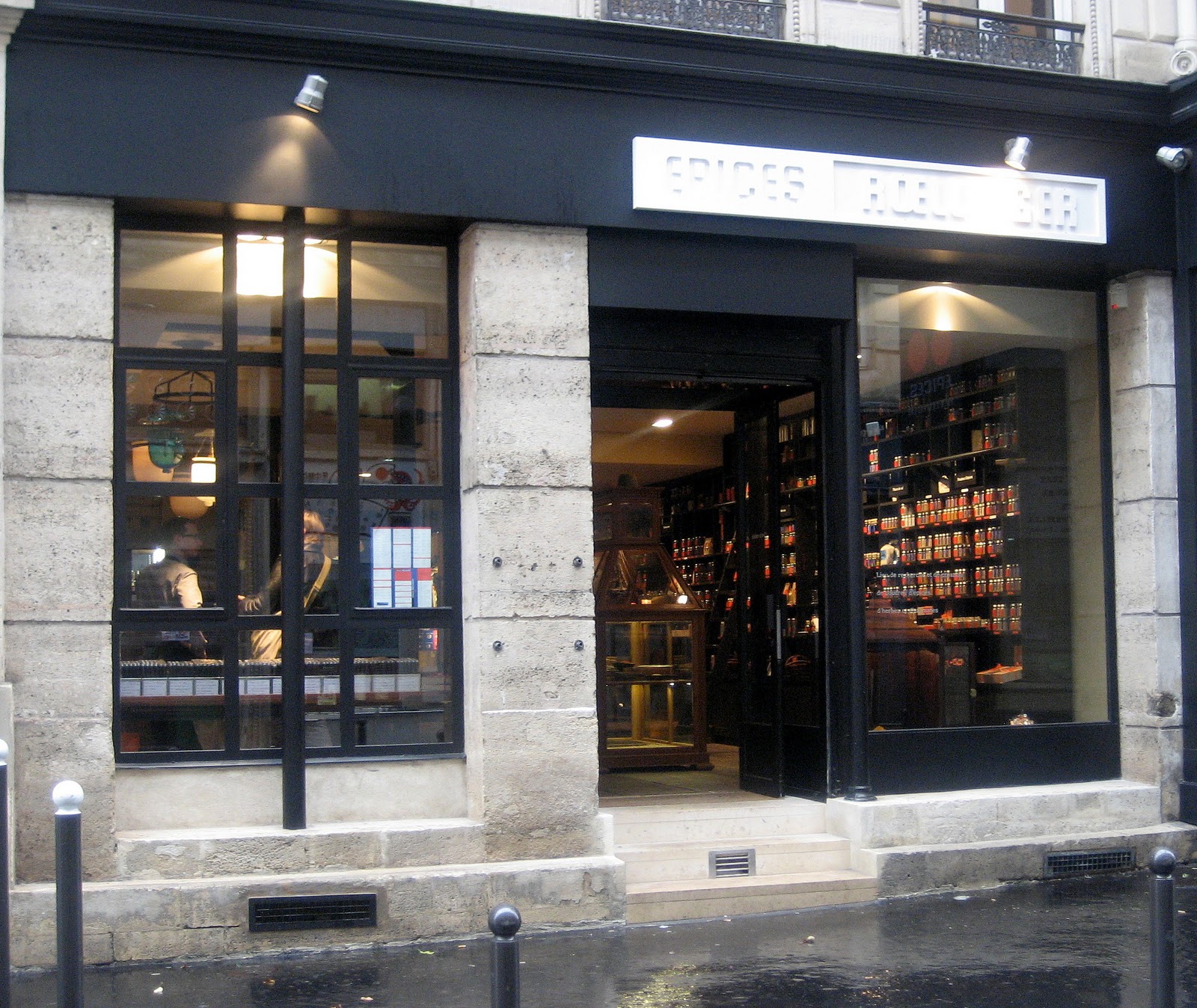
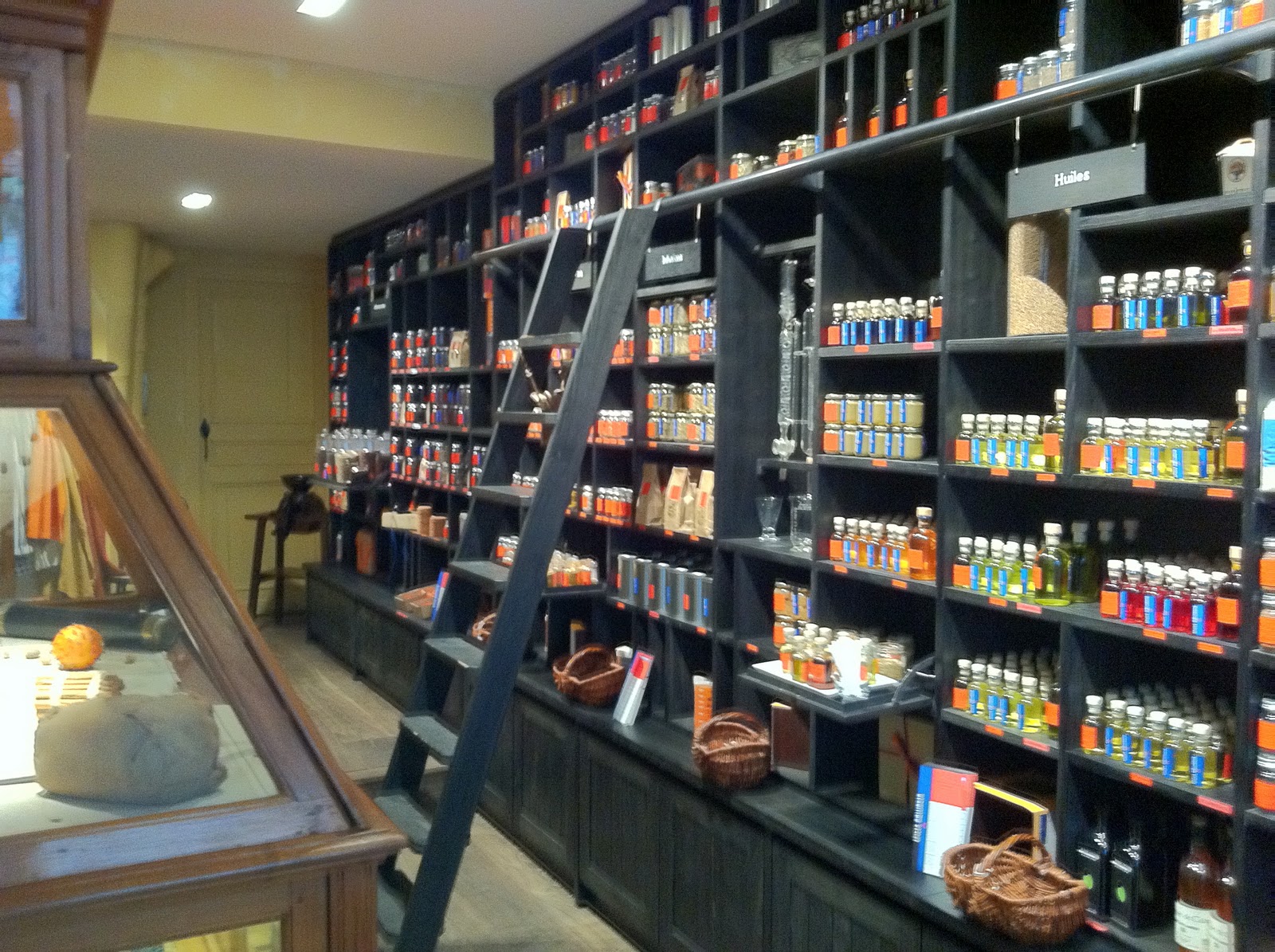
Paris is a city of delicious discoveries. At a dinner with friends, someone mentioned that they had been to a new shop called Epices Roellinger, on a narrow street near the Place de l’Opéra. The next day my husband and I found our way to the small boutique, chock full of colorful bottles and containers of aromatic spices. The owner, Olivier Roellinger, travels the globe in search of the best examples. He then concocts his own blends,  packages them, and adds labels that explain the mixture, with suggestions for food pairings. In addition, there’s an incredible selection of more than 20 types of vanilla beans and a case devoted to peppercorns, some quite rare.
Sandrine, the warm and welcoming manager of the Paris store (other boutiques are in Cancale and Saint Malo), is knowledgeable and helpful with selections. I came back to the apartment with beautiful Mexican vanilla beans that had an enticing, slightly smoky bouquet, some Poivre des Mondes (a global peppercorn mix), two blends from India, Retour des Indes and Poudre Grande Caravane (both robust seasonings), and some Vinaigre Celtic Épicé (a small bottle of spiced apple cider vinegar). The spice blends run around eight euros each; the vinegar and my Mexican vanilla beans are in the same price range.
The pepper made an omelet extra special. The Grande Caravane added superb flavor to a winter squash soup, and a few drops of the cider provided a fine accent to a slice of mild Comté cheese.
The store has a website in French, which you can also view in English by pushing the tab for “English” on the lower bar of the home page. Sandrine did mention that they can send parcels Fed Ex.” 
Épices-Roellinger
51, rue Sainte-Anne
Paris 75002
www.epices-roellinger.com

Shopping in Paris

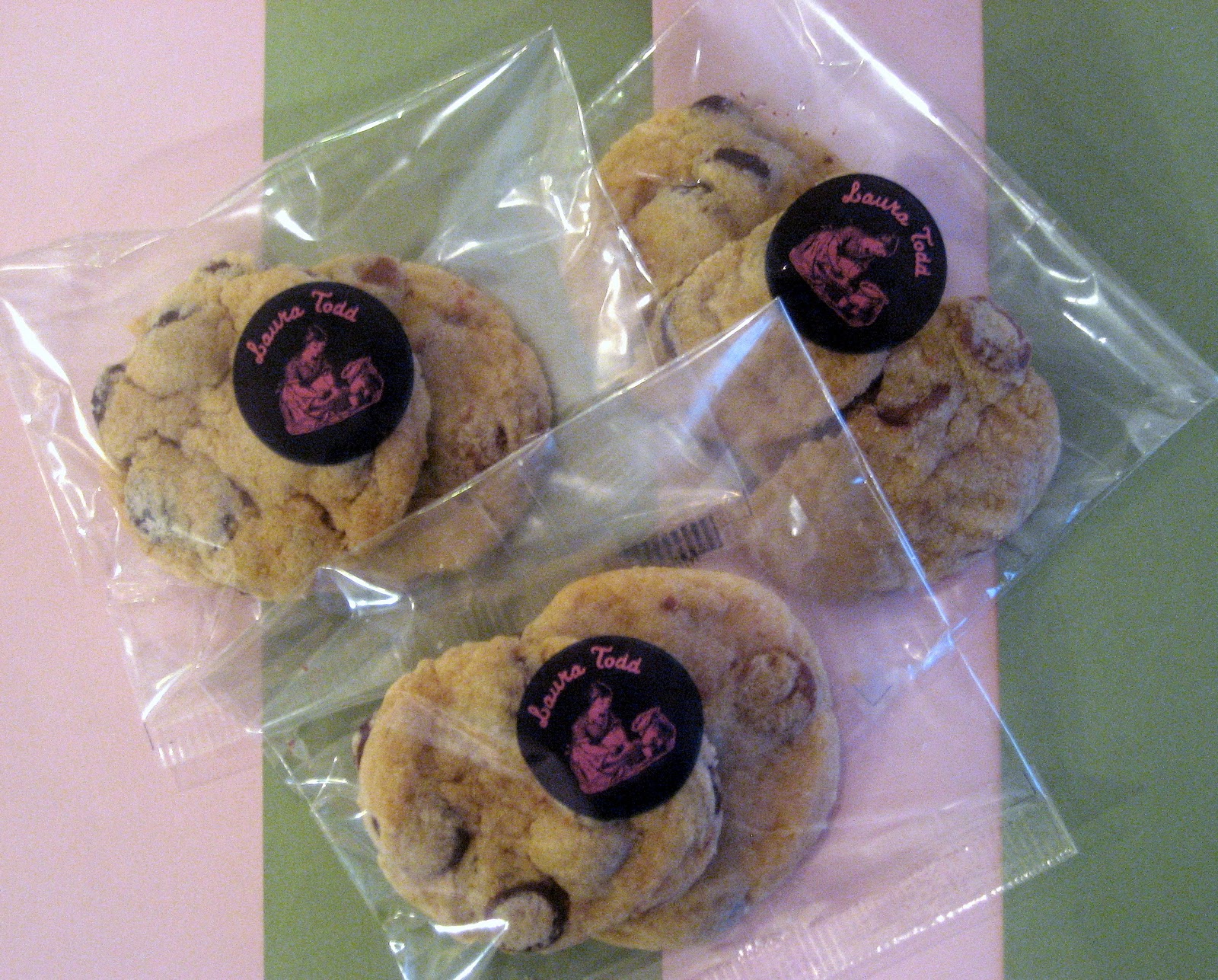
Two of my favorite pastimes—shopping and eating—merged perfectly today. I rose early and took off for Bon Marché Department Store, Paris’s famous Left Bank emporium, for the first day of the semi-annual sales. There, at every entrance of this 19th century retail colossus, were men and women in black suits, holding big baskets filled with packets of chocolate chip cookies. As customers arrived, the welcomers smiled and handed each a package with two chocolate chippers inside. This imaginative custom is extended to early-bird shoppers, and I didn’t want to miss it. What a Parisian way to open the winter sales season!

This year the store extended its gustatory generosity to its upper floors as well. By the time I had made all my rounds, I had collected three gifts, totaling six delicious cookies, enough to keep me nourished as I shopped. I left the store with four cookies, two fabulous tops, and a pair of charcoal wool pants!

Hot Chocolate French Style

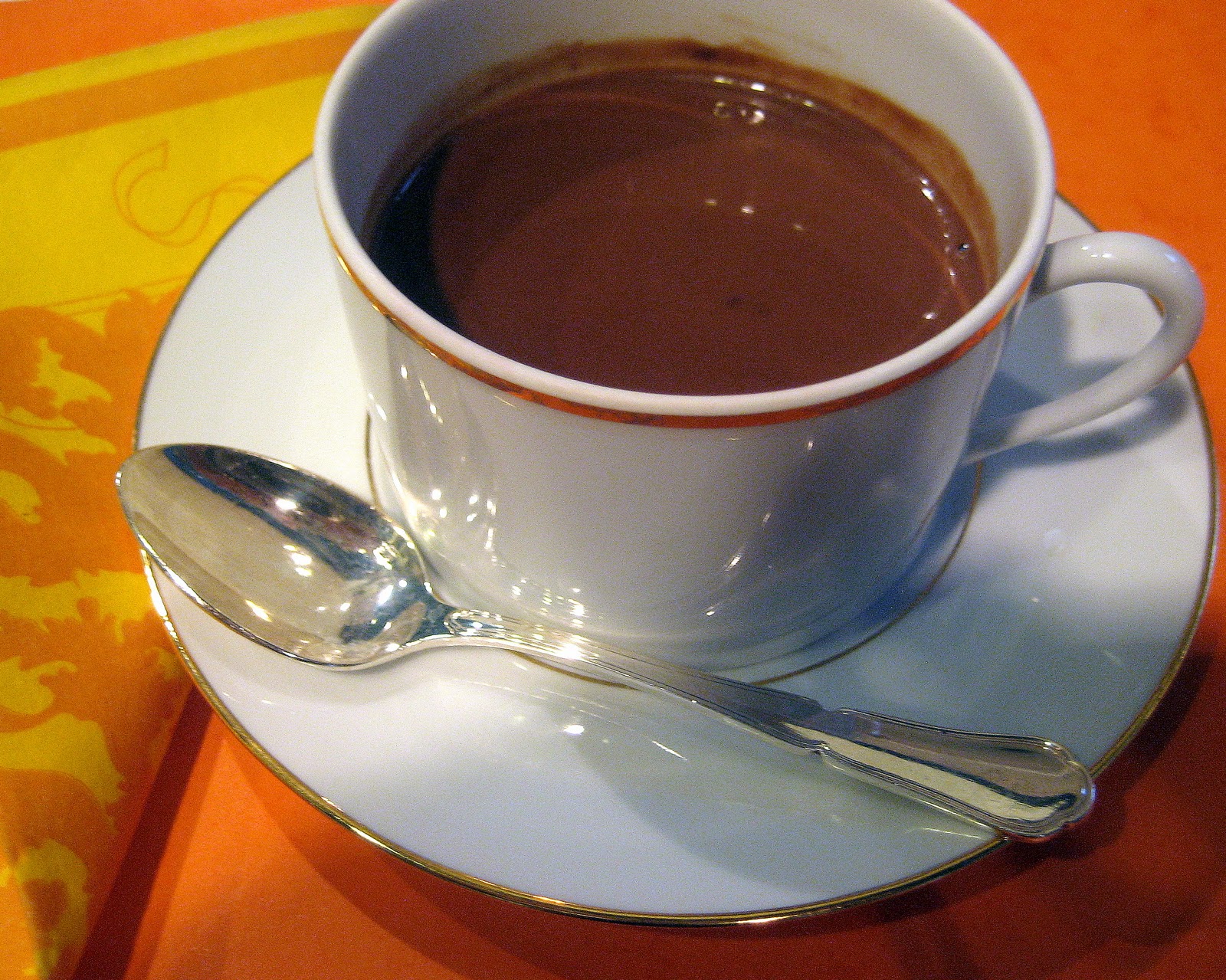
Last weekend, leaving the marché bio loaded down with purchases, I noticed a vendor selling hot chocolate. A born chocoholic, I could never pass such a concession without trying a sample, so I bought a cup to share with my spouse. Within minutes we had downed the rich, thick, dark liquid, which put us in a state of bliss. As soon as I got back to the apartment, I tried duplicating the recipe with good results, so once again we indulged in this ambrosial beverage.

The following evening at our dinner table, a young Amherst alum in Paris for a few days with his girl friend mentioned that he had tried the hot chocolate at Angelina’s, a Right Bank tea room renowned for their cups of this sumptuous brew. I listened enthralled as this strapping hockey player rhapsodized about the French version of one of his family’s favorite hot drinks. When I told him that I knew how Chocolat Chaud à l’Ancienne was made, you would have thought I’d offered him a contract with the Toronto Redwings. “Please send it to me,” he politely begged.
 Here’s my version, a close facsimile of that delectable Parisian original!  
4 ounces dark chocolate, 70% cacao (See note.)
2 cups milk, either whole or 2 %
2 tablespoons unsweetened cocoa powder, preferably Dutch-process style
2 tablespoons sugar plus more if needed
Coarsely chop the chocolate and place it and the milk in a medium, heavy saucepan. Place the pot over low heat. Stir the mixture constantly with a wooden spoon until the chocolate has melted, taking care to scrape any chocolate bits on the bottom of the pan into the liquid. Raise the heat to medium and then gradually, with a whisk, add the cocoa powder and the sugar. Continue to cook, whisking constantly, until the mixture has thickened and reduced to about 2 cups, about 12 minutes. If necessary, lower the heat so that the mixture does not boil.
Taste a spoonful (it will be quite hot so let it cool for a few seconds), and, if desired, add more sugar by 1/2 teaspoon amounts.
Pour the warm chocolate into 2 standard-size coffee cups or mugs or into 4 espresso-size cups.  Serves 2 to 4.
Note: I used Nestlé’s 70 % chocolate. Scharffenberger’s 70% bittersweet bar and Ghiradelli’s  extra bittersweet 70% baking bar are available in many US groceries. Depending on the chocolate you use, you may want to add additional sugar to your hot chocolate as the recipe directions suggest.

Cooking from the Marché Bio

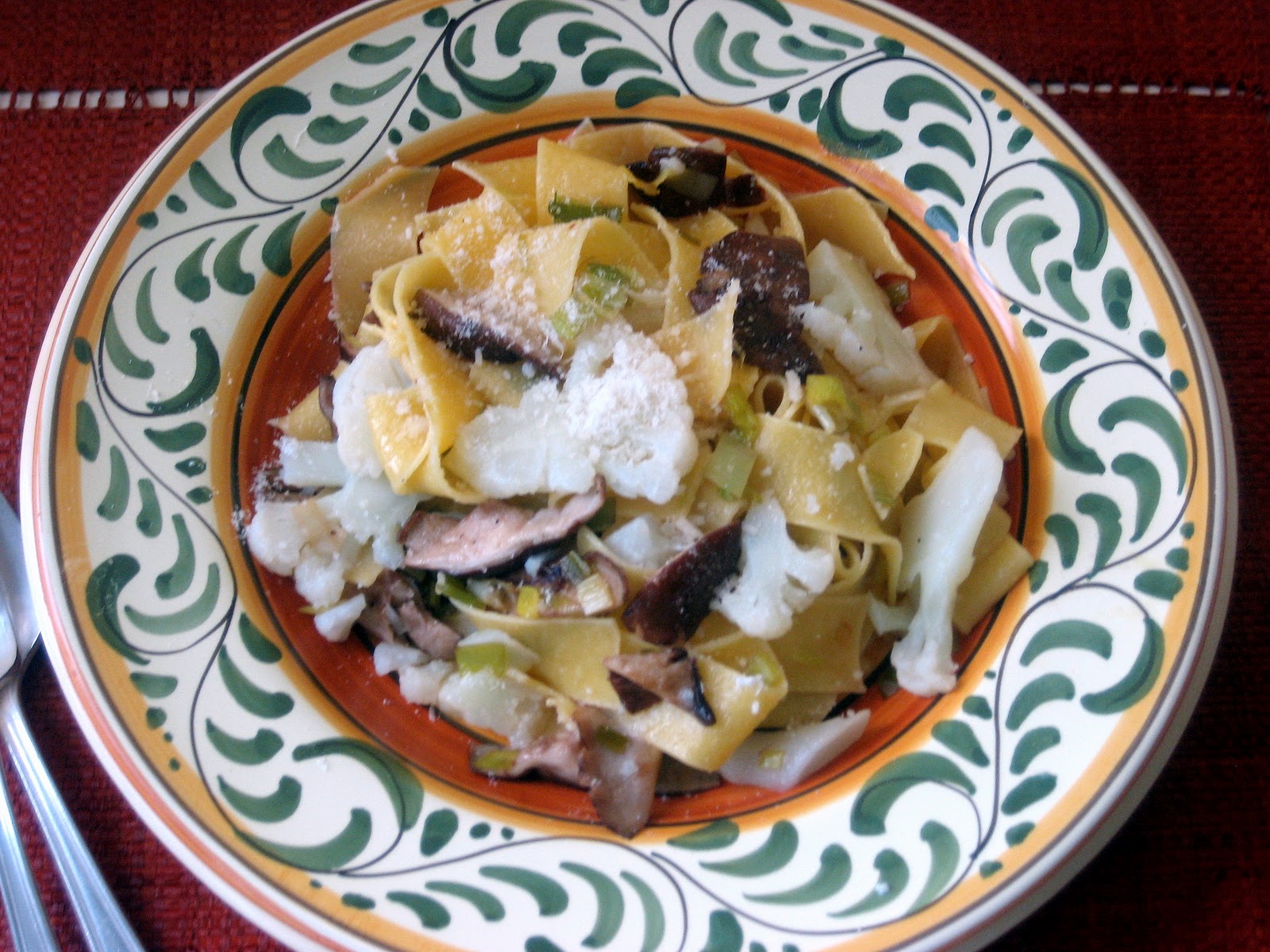
Nothing is a bigger thrill for me, even when it’s freezing outside, than to go to Paris’ Marche Bio. (See my detailed description of this outdoor food market under “Out and About” on my website). Even my spouse, an avowed non-cook, finds this French food market fascinating. Sunday, our haul included winter vegetables, great mushrooms, and some delicious prosciutto known as jambon de Parme over here. I used it all for a menu that starred the savory pasta dish that follows. The recipe, which takes about 45 minutes  from start to finish, makes a perfect cold weather main course.

Pappardelle with Cauliflower, Leeks, and Mushrooms
12 ounces shiitake mushrooms  

A 2 1/2 to 3 pound cauliflower

4 tablespoons olive oil
6 tablespoons unsalted butter, divided  (See note.)
3 cups chopped leeks, white and light green parts only
1 pound pappardelle (If these wide pasta strands are unavailable, use fettuccine.)
Kosher salt
1/2 cup grated Parmesan, preferably Parmigiano Reggiano
Remove the stems from the mushrooms and save for another use or discard. Wipe the mushrooms clean with a dampened paper towel and slice them into 1/2 inch-wide julienne strips.
Remove the base from the cauliflower and cut the head into florets. Cut the florets into 1/4 inch slices to yield 3 cups.
Heat the oil and 4 tablespoons of the butter in a large, heavy skillet set over medium heat. When hot, add the mushrooms and leeks, and cook, stirring often, until both are softened, 5 to 7 minutes. Remove skillet from heat. (Mushrooms and leeks can be prepared 4 hours ahead; leave at room temperature and reheat over medium heat, stirring.)
Bring a large pot of salted water to a boil. Add the cauliflower slices and cook until tender, 4 to 5 minutes. Remove with a strainer or a slotted spoon to drain. Add the pasta to the pot and cook according to the package directions. Drain well in a colander and return the pasta to the pot. Stir in the remaining butter until it has melted. Then add the leeks and mushrooms and the cauliflower. Toss to mix. Season the mixture well with salt.
Mound the pasta in shallow bowls or on dinner plates, and garnish each serving with a good sprinkling of Parmesan cheese. Pass extra cheese separately in a bowl. Serves 4 to 5 generously as a main course.
Note: Don’t skimp on the butter as it provides great flavor and keeps the pasta from being dry.

Travel Travails

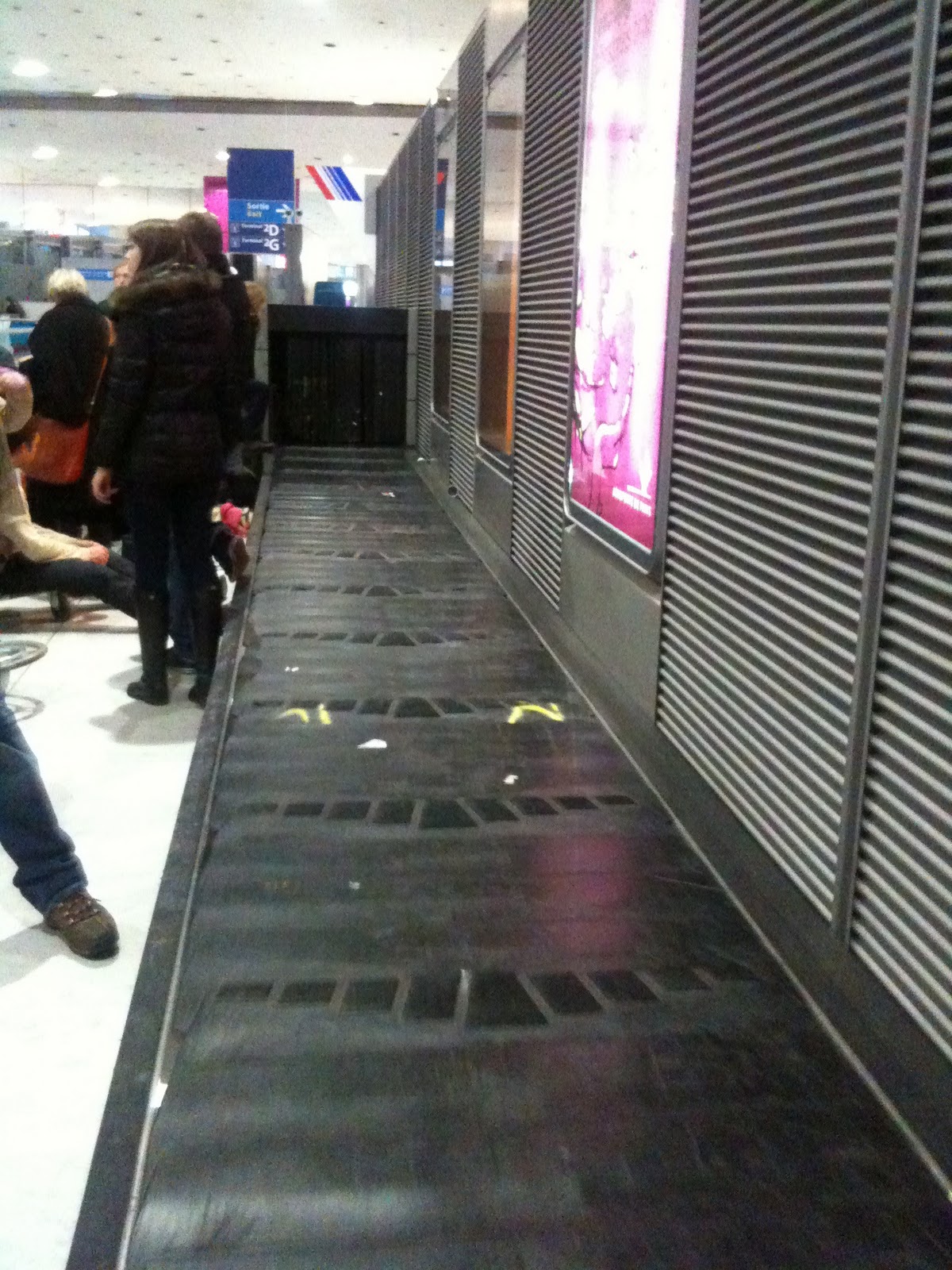
Lucky that our flight to Paris from Boston was 36 hours after the blizzard of the year hit New England, we touched down at De Gaulle Airport in perfect weather. Whew. Then, we hit something worse than a blizzard: the baggage handlers at De Gaulle Airport. Thirty minutes went by, then an hour, then another 30 minutes: still no bags. The Air France officials were quite helpful: “Not enough containers.” We began making friends with the other frustrated passengers. Finally, a full two hours after landing, our suitcases appeared on the conveyor belt. As I learned from our taxi driver, 10,000 bags had been abandoned at the airport during Paris’ own weather-related turmoil. Still, it took us longer to get our luggage than it took to drive from Amherst to Boston!
At our small apartment rental, my husband and I started to set up our computers. His connected right away, but mine met with a glitch. Two hours went by (a familiar time frame) and several emergency phone calls were made to the States. I, famished and not wanting to panic, went out to buy dinner.
At a favorite bakery I bought a crusty pain de campagne and a ficelle aux lardons (a thin baguette studded with bacon). Next I picked up cheeses –a smoked chèvre, a slice of Roquefort, and another of Comté (a buttery cheese that looks like Gruyère).  At a charcuterie, I purchased perfectly roasted potatoes and steamed winter vegetables. Finally, at the local grocery, I found beautifully trimmed lamb chops packaged with pats of beurre aux fines herbes and some flageolets, those light green, kidney-shaped beans that complement lamb so well, but have yet to find their way to our grocery shelves.
Back in my tiny kitchen, I quickly sautéed the chops, topped them with the herbed butter, and reheated the vegetables and beans. At that moment, my husband announced that I was again on line! Our delicious, but simple dinner tasted even better, causing the travails of our voyage to vanish completely!  We finished with cheeses and bread, and remembered why we love to come to France, baggage or no baggage—for the food, of course. 
Beurre Aux Fines Herbes
For my version place 4 tablespoons of softened, unsalted butter in a bowl; stir in 2 tablespoons finely chopped fresh herbs (a combo of tarragon, parsley, and chives with an emphasis on the tarragon). Add 1 to 1 1 /2 teaspoons white wine vinegar to balance the sweetness of the butter and 1/4 teaspoon kosher salt. Mix well with a fork.  Roll into a log and cut into rounds to serve atop sautéed, grilled, or broiled lamb chops.

Merry Christmas and Happy New Year!

Dear Readers,
Although this blog and website are only a month old, many have already visited. I’d like to thank each of you who have read my posts and clicked on all those different pages on my new site. I love this high tech (well for me anyway!) way of keeping in touch with others who love food and cooking.
There’s a lot on the schedule for the new year—reports from Paris, new recipes to stave off the cold for those who live in chilly climes, and tips on the latest cookbooks, kitchen tools, and food trends. Stay tuned!
Meanwhile, I’d like to wish each of you joyful holidays filled with delectable indulgences and a happy and healthy 2011!
                                    Betty

So Simple, So Delicious—Scallops to Begin Your Holiday Feast!

This is the time of year when I feel like I’m a doctor on call. The other day at a lesson with my computer guru, the teacher only wanted to talk about eggnog. During my Christmas cooking class last week, the Q and A lasted so long that the course ended late. At the supermarket, friends greet me with questions about the roasts and birds they’ve chosen for their holiday menus, and as December 25th approaches, there will be urgent emails and frantic phone calls. Everyone seems to want recipes (or should I say prescriptions!) for dishes that are extra special yet failsafe.   
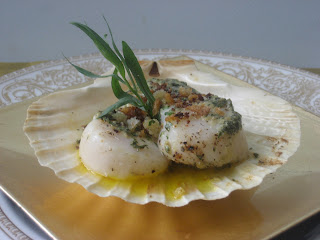
Roasted Scallops with Tarragon Mustard Butter delivers on both fronts. The shellfish are arranged in individual scallop shells, dotted with a flavorful butter, and then roasted for about 12 minutes. A garnish of golden toasted bread crumbs adds color and texture. Both the butter and bread crumbs can be prepared a day ahead so there’s no last-minute stress. These succulent scallops floating in pools of melted herbed butter would make a showstopper beginning for a Christmas or a New Year’s Eve dinner.
If you have any questions about the recipe or about holiday entertaining, I’m “on call.” Just send me a note via “comments” on this post, and I’ll answer as soon as I can!
Roasted Scallops with Tarragon Mustard Butter
Tarragon Mustard Butter
6 tablespoons unsalted butter, softened   
3 tablespoons chopped fresh tarragon, plus 6 sprigs for garnish
1 tablespoon Dijon mustard  
2 teaspoons tarragon vinegar (or white wine vinegar)
1 teaspoon fennel seeds, crushed (See cooking tip.)
1/4 teaspoon Kosher salt and several grinds of black pepper
Scallops
1/2 tablespoon olive oil
1/2 cup coarse fresh bread crumbs (See cooking tip.)
18 large sea scallops about 1 ounce each, side muscles removed
Kosher salt and freshly ground black pepper
6 scallop shells, crème brûlée dishes, or 1/2 cup ramekins
For Tarragon Mustard Butter, in a medium bowl mix together the butter, chopped tarragon, mustard, vinegar, fennel seeds, salt and pepper until well blended. (The butter can be prepared 1 day ahead; cover and refrigerate. Bring to room temperature until softened before using.) Makes about 1/2 cup.
For scallops, heat oil in a medium, heavy skillet over medium heat. When hot, add the bread crumbs, and cook, stirring constantly until they are crisp and golden brown, 3 to 4 minutes. Remove from them from the skillet and place on a plate. (Bread crumbs can be prepared 3 hours ahead; cover with plastic wrap and leave at room temperature.)
To roast scallops, arrange a rack at center position and preheat oven to 400 degrees F.
Use about 1/2 teaspoon of the Tarragon Mustard Butter to coat each of the scallop shells (or dishes). Pat scallops dry and place 3 scallops in the center of each shell. Dot the scallops in each shell generously in the crevices and on the tops with a generous tablespoon of the butter. Salt and pepper scallops. 
Roast until scallops are opaque and cooked through and butter has melted, 11 to 12 minutes. After 6 minutes, use a spoon to baste the scallops with some of the melted butter in their shells.
Remove and sprinkle each serving with some bread crumbs. Garnish with a tarragon sprig. Serves 6.
  
Cooking tip: To crush fennel seeds, place in a self-sealing bag and pound with a meat pounder or rolling pin, or use a mortar and pestle. Or, use a small spice grinder and ground the seeds coarsely.
          
Cooking tip: Use a good quality peasant loaf with crusts removed. Cut the bread into chunks and place them in a food processor. Pulse just until you have coarse crumbs.

5 Great Gifts Under $50 for the Food Lovers on Your List

William Sonoma Cooking at Home and Bon Appétit Desserts
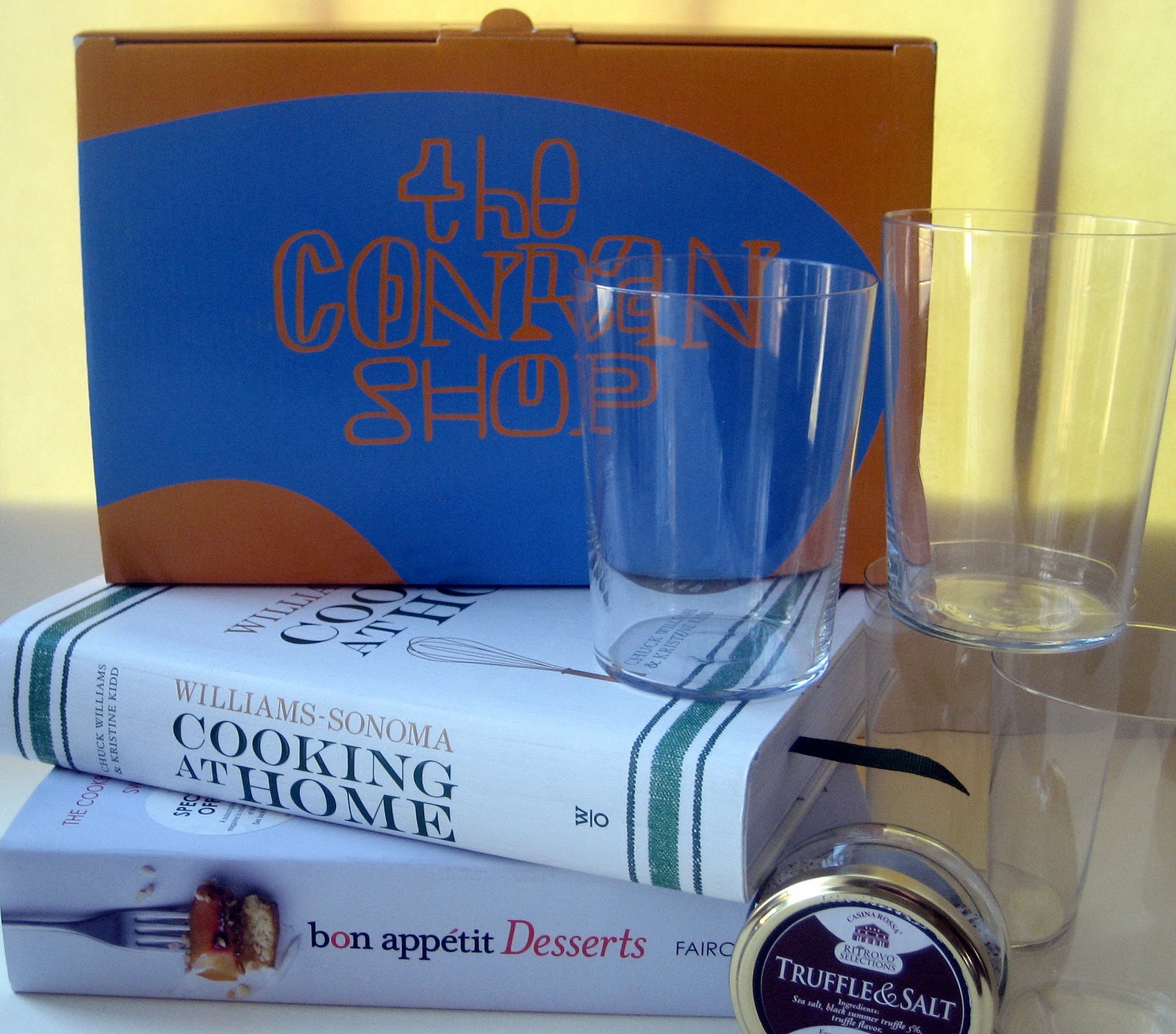
These two huge books deliver big bang for your bucks. The first, authored by Chuck Williams, the founder of Williams Sonoma, and Kristine Kidd, a former food editor for Bon Appétit, includes 1000 recipes and is priced at $34.95 (Weldon Owen Publishers). The other, written by former Bon Appétit editor-in-chief Barbara Fairchild, boasts 600 delectable confections and costs $40 (Andrews McMeel Publishing). As a bonus you get a year’s subscription to the magazine with your purchase of the Bon Appétit book. Both are available in bookstores and at Amazon.com.
Glass Tumblers from The Conran Shop
These extra thin, sleek tumblers would make a great present for those who love to entertain. I have found multiple uses for them. They’re great as chic glasses or as cups for desserts like sundaes. I also use them as vases. I fill them with flowers and arrange several on my holiday table. They are $4 each. You can find them at www.conranusa.com. (search for Gio clear glass tumblers) and at The Conran Shop in ABC Carpet and Home in New York (on the lower level).  At the New York shop they even have these glasses attractively packaged in one of their boxes.
Truffle Salt
A real extravagance, this sea salt scented with bits of black truffle, packs a lot of flavor. My colleague, Elinor Klivans, told me about it, and now I’m hooked.  Sprinkle it on popcorn or scrambled eggs. Season polenta with it, or rub it on a good steak. This small bottle would be a great stocking stuffer. It’s $28 at Williams Sonoma (www.williams-sonoma.com) and also available at other cookware and food stores.
A Round of Stilton Garnished with Dried Fruits and Nuts
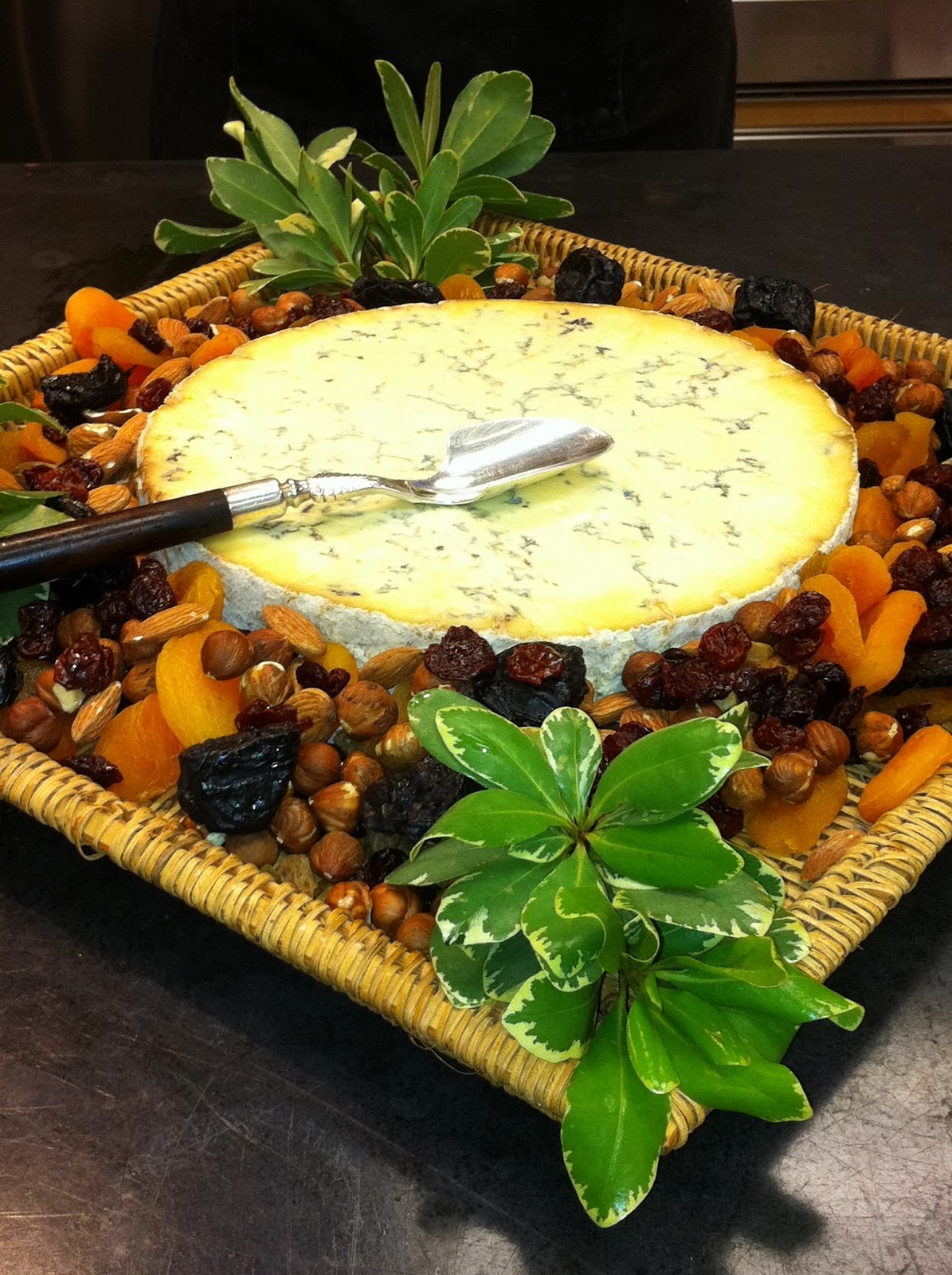
This is a “make-it-yourself” gift. Buy a round of English Stilton about 1 inch high at your favorite cheese shop. Then place it on a wicker tray and garnish with some pine or other Christmas greenery.  Surround the wheel with dried almonds, hazelnuts, walnuts and dried apricots, cherries, raisins, and prunes. Wrap in cellophane and tie with ribbons. Keep refrigerated until you’re ready to give it to the lucky recipient.  A 1-inch round of Stilton purchased at Whole Foods cost me $48.

The French and Their Foie Gras

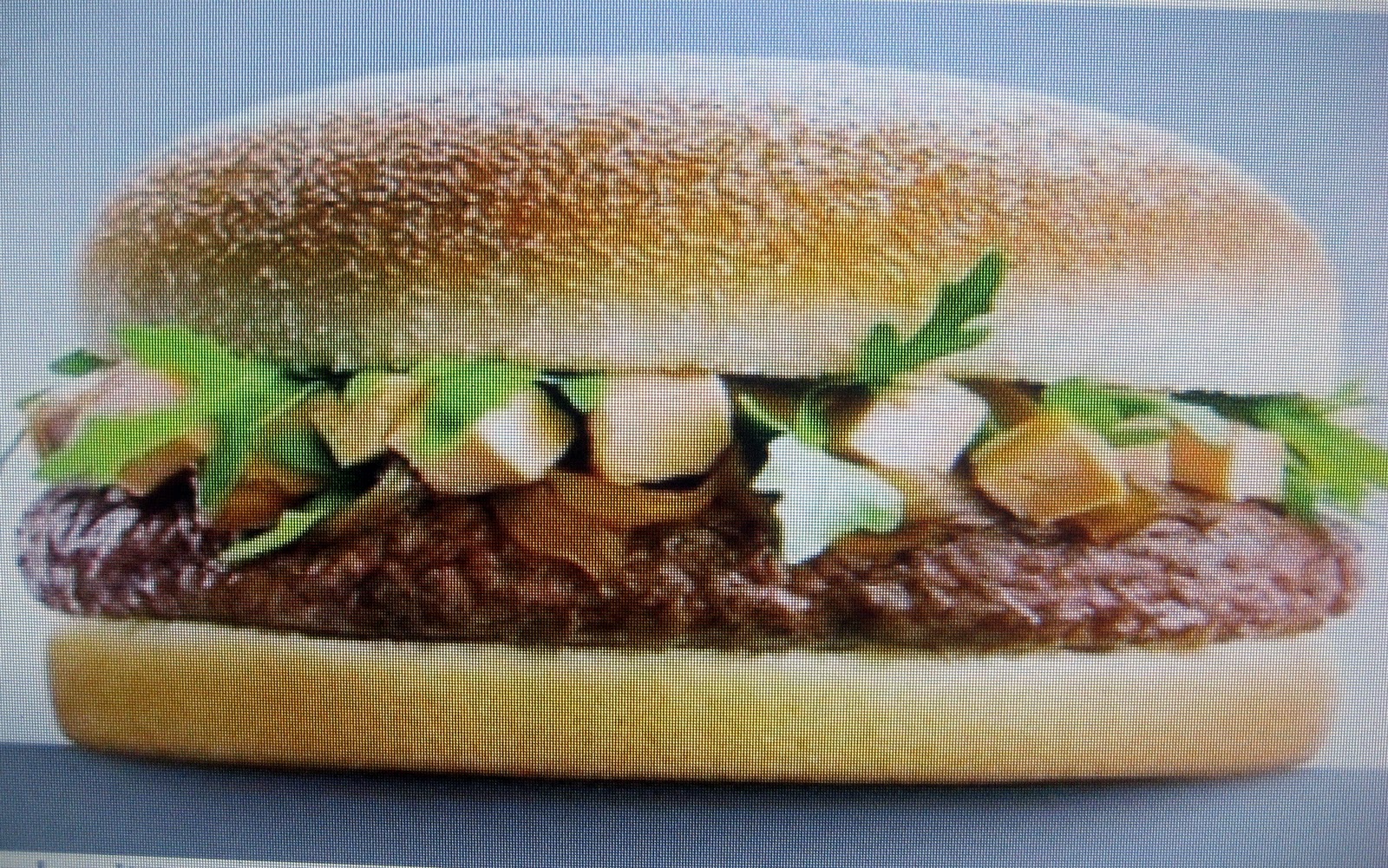
Leave it to the French to come up with a fast-food special that includes foie gras. While reading the Provence Post (www.provencepost.com), a terrific blog written by American Julie Mautner who lives in southern France, I learned that Quick, a French and Belgian chain, will be offering what it calls the “Supreme Foie Gras,” a beef burger topped with duck foie gras, relish, and lettuce, for 5 euros (a little more than $6). It will be a pre-Christmas special from December 17 to 19 at more than 300 of its outlets throughout France.
Although foie gras  (literally “fat liver”), produced from the super-sized livers of force-fed ducks and geese, is shrouded in controversy (many protest the practice of force-feeding), this luxury item remains a traditional favorite for the French, especially during the holidays. The chain explained that they wanted to give their customers a chance to start the holiday season early!